
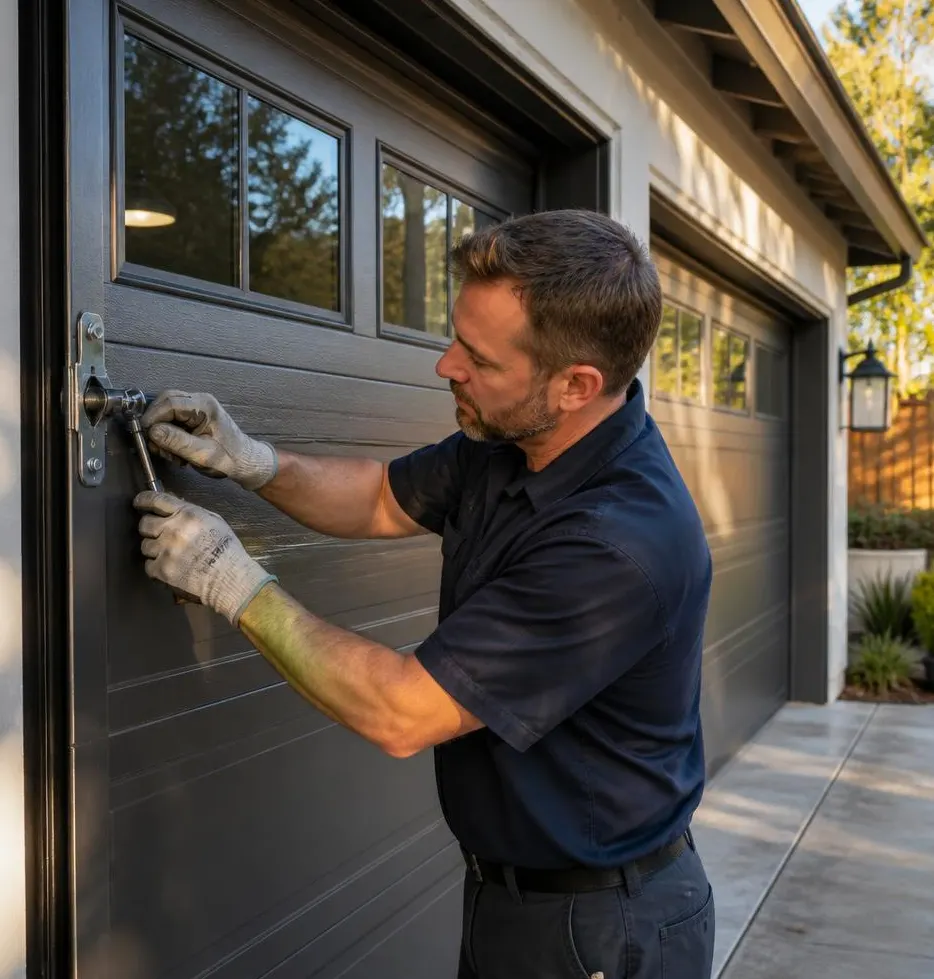
The Rule, and the Honest Exceptions
If the job involves a torsion or extension spring, don't do it yourself — call someone who does this for a living. That's the rule. The exceptions are narrow: lubricating a spring you can already see, visually inspecting it for rust or gaps, or noting that it's broken so you can call for a replacement. None of those involve touching a wound spring, loosening a set screw, or unwinding anything. The moment a repair requires winding bars, clamps, or taking tension off a coil, the exception list ends.
What Actually Goes Wrong
A standard torsion spring on a residential garage door holds somewhere between 100 and 200 pounds of stored force, wound tight around a steel shaft above the door. An extension spring, stretched along the horizontal tracks, carries a similar load under tension. Both are designed to control a door that can weigh well over 150 pounds. When that stored energy is released in a controlled way by someone trained to do it, nothing happens. When it's released by accident, it happens all at once.
Here's the sequence that sends people to the emergency room:
- The set screws let go mid-adjustment. A homeowner loosens the screws on a torsion spring without a winding bar locked in place to control the coil. The spring unwinds instantly, and whatever bar, screwdriver, or wrench was near it becomes a projectile.
- A spring breaks under load. If someone is standing under or near the door when an old, worn spring finally snaps, the sudden loss of counterbalance can cause the door to drop fast, and flying spring fragments or cable ends can strike hands, arms, or face.
- The cable whips. Extension springs are usually paired with safety cables for exactly this reason — without one, a failed spring can send a cable snapping through the garage with enough force to cause deep lacerations.
The injuries that result aren't minor: crushed fingers, broken hands, facial cuts, and in the worst cases, blunt-force trauma from a door that falls unexpectedly while someone is working underneath it. This is why national injury data consistently lists garage door springs among the more dangerous DIY home repairs, right up there with roof work and electrical panels.
Torsion vs. Extension: Why It Matters
Torsion springs sit on a shaft above the door and require specific winding bars sized to the winding cone, plus a vice grip clamped to the shaft to prevent it from spinning while you work. Extension springs run along the tracks and stretch under load, with less specialized tooling but still enough force to cause serious injury if a safety cable isn't installed or the spring is older and brittle. Neither type forgives improvised tools. A screwdriver substituted for a winding bar can slip, bend, or shatter under load, and that's usually the moment an ER visit happens.
What Actually Prevents These Injuries
The fixes aren't complicated, but they're specific:
- Keep hands and tools away from the spring area entirely. If a spring is visibly broken, sagging, or has a gap in the coils, treat that section of the garage as off-limits until it's replaced.
- Never use a screwdriver, pliers, or a drill as a substitute for proper winding bars. The tools matter as much as the technique.
- Don't work under an open door that isn't propped with a solid support. Hydraulic pressure from the opener isn't a substitute for a mechanical brace.
- Unplug the opener before doing any manual work on the door — including testing the door's balance by hand — so it can't engage unexpectedly.
- Leave spring tensioning and winding to someone with the right clamps, bars, and experience. This is the step that actually prevents the injury, not just reduces its chances.
What you can safely do yourself: lubricate hinges, rollers, and the spring itself with a garage-door-rated lubricant; wipe down tracks; tighten loose bolts on brackets (not the spring assembly); and watch for early warning signs like a door that feels heavier than usual, makes a loud bang, or closes unevenly. Those symptoms usually mean a spring is failing before it fully breaks, which is the best time to get it replaced.
Why Local Conditions Make This Worse
Humidity and heavy rain through the warmer months accelerate rust on spring coils and cable ends, which weakens them faster than in drier climates. Pine sap and debris can build up in tracks and hide early signs of wear. And when an ice storm hits and adds extra weight and stiffness to a door, a spring that was already marginal is far more likely to fail at exactly the wrong moment — often with someone standing nearby trying to force the door open by hand.
When to Call Wilson Garage Door
If a spring looks stretched, rusted, gapped, or has already snapped, that's a job for our Spring Replacement service — we bring the correct winding bars, clamps, and springs rated for your door's weight, and we handle the tensioning safely. If you're not sure whether a spring is failing or just old, our Garage Door Maintenance visits include a full inspection of springs, cables, and hardware so small problems get caught before they become dangerous ones.
If your garage door in Wilson, NC is making noise, feels heavy, or has a visibly worn spring, don't reach for the winding bars yourself — call Wilson Garage Door and we'll handle it safely, the same day when we can.